
Records for an Algonquin Lookup
One name can appear in several official systems, but each record answers a narrow question. Algonquin lies in McHenry and Kane counties, so the resident lookup must follow the county connected with the event, parcel, or case. Begin with a current roll when the question is present-day identity. Use historical or vital material when the goal is an heir, relative, former classmate, or earlier resident.
| Record | What It Confirms | Where | Access |
|---|---|---|---|
| Property roll | Tax owner, site and mailing fields, PIN | McHenry or Kane DevNet | Free web search |
| Voter lookup | Registration status and election geography | Illinois or Kane voter search | Limited public lookup |
| Court index | Case, party role, dates and disposition | 22nd or 16th Circuit Clerk | Web index, terminals, copies |
| Vital record | Birth, death, marriage, or divorce event | County clerk, IDPH, or circuit clerk | Eligibility varies |
| State filing | Business role or professional credential | SOS or IDFPR | Free single search |
A tax-owner result does not prove who occupies a home. Likewise, a business address does not establish personal residence. Match the source to the question, then confirm the person through a second custodian. That is the core of a sound Algonquin resident lookup.
Key the Algonquin Name to County
County is the first identity filter. McHenry County cases use the Twenty-Second Judicial Circuit, while Kane County cases use the Sixteenth. Deeds, marriage certificates, assessor cards, and voter administration also split at that line. An Algonquin mailing address alone may not tell you which office holds the record.
Start with a parcel number, full address, case number, event county, age, spouse, or relative. Keep spelling variants, middle initials, and former surnames. A common name matched only to “Algonquin” is weak evidence. A name plus the right county, address, date range, and role is far more useful. If the aim shifts from one person to every address on a road, use the Algonquin street directory method instead.
Note: A village boundary, postal city, township, and county line can describe the same address differently, so save each label separately.
Read Algonquin Court Lookup Fields
The McHenry Circuit Clerk online services route provides basic public case information and points to courthouse terminals at 2200 North Seminary Avenue in Woodstock. Public terminals are on the first and third floors. Web document images are more limited than the index. Kane offers a court-date search by last name, optional first name, or case number, with a 30-day calendar window. That calendar aid is not the complete docket.
| Search control | Use | Important limit |
|---|---|---|
| Party name | Try full name and variants | Portal fields were not fully inspectable |
| Case number | Best key for a known file | County-specific format |
| Kane last name | Required in name mode | First name is optional |
| Case type, date, status | Separate likely matches | Availability varies by portal and role |
A docket may report a case number, title, filing date, case type, judge, party names and roles, events, courtroom, disposition, and document metadata. It may show an image flag without the image. Sealed, expunged, juvenile, adoption, and other confidential matters are withheld or redacted.
Verify an Algonquin Resident Record
Never merge two people because their names look alike. Build a short identity key and make each source support a separate part of it. This process works for a resident lookup involving a parcel owner, voter, court party, or person named in a public filing.
- Confirm the county and anchor the name to a full address or PIN in the appropriate assessor roll.
- Search the recorder or court index with the name, alternate spelling, and known date range.
- Compare role, county, filing date, spouse or relative, and address fields. Do not rely on name alone.
- Request the public file or a certified copy from its custodian when the result must carry official weight.
If the online portal fails, use the courthouse terminal, clerk copy request, telephone, or mail channel described by the office. Under the Illinois Freedom of Information Act, 5 ILCS 140, a defined request for an existing local record normally receives a response within five business days, with a permitted five-business-day extension. Court and vital access rules still control protected files.
- Docket
- The dated list of filings, hearings, actions, and results in one court case.
- Index versus image
- An index describes a record. An image reproduces the filed document and may have tighter access.
- Certified copy
- A custodian-issued copy carrying formal proof that it matches the office record.
Use Algonquin Voter Lookup Narrowly
The Illinois voter registration lookup is the statewide starting point. Kane County also publishes a voter search that can return registration status, precinct, polling place, voting districts, and a sample ballot. These public tools are designed for the voter, not as a downloadable street roster.
Illinois Election Code rules, including 10 ILCS 5/5-7, tightly limit electronic voter data and its use. A no-result may reflect incomplete inputs, the wrong county, a recent update, or protected handling. It does not prove the person is not an Algonquin resident. Contact the relevant election authority for correction or a lawful, defined request.
Confirm Algonquin Vital Events
Birth and death records use the Illinois Department of Public Health or the county clerk serving the event. Marriage certificates come from the county where the ceremony occurred. Divorce decrees come from the circuit clerk. Modern certified copies require the relationship, authority, identification, and purpose specified by the current form.
Genealogy access has two distinct clocks. Under 410 ILCS 535/24, designated archive or library inspection reaches births at least 100 years old, deaths at least 50 years old, and marriages at least 75 years old. IDPH also offers genealogical products under its own rules for births older than 75 years and deaths older than 20 years. Do not treat those thresholds as one broad public-access rule.
For a classmate or an older family link, the Algonquin Area Public Library District and McHenry County Historical Society hold yearbooks, local newspapers, obituary tools, and county directories. The digitized 1877 taxpayer and voter directory offers another name snapshot, but it is historical evidence, not a modern address source.
Find Algonquin Heirs and Relatives
Probate is the best public starting point for an heir or fiduciary. Search the circuit clerk in the county where the estate was filed, note the decedent, case number, representative, and public disposition, then compare an obituary and any deed transfer. Use only the public portion. A named person in a filing may have a procedural role and may not be an heir.
Birth-relative questions follow a safer route. The Illinois Adoption Registry and Medical Information Exchange is consent-based. Illinois DCFS also explains the court-ordered Confidential Intermediary Service. Both protect sealed records and personal choice. They should replace any attempt to reconstruct a protected address trail.
Older McHenry court records reach the 1850s and include the 1846 Eli Henderson cases linked to an early Algonquin settler and a Lincoln appeal. This courthouse history is useful for genealogy because older material may sit with the clerk or IRAD rather than in the modern portal.
Confirm Algonquin Public Affiliations
The Illinois Secretary of State entity search accepts business name, registered agent, president, secretary, manager, or file number. A detail can show entity status, formation date, jurisdiction, agent, officers or managers, registered office, and file number. These facts confirm a filing role. They do not prove present residence.
The IDFPR license lookup reports name, license number and type, status, city and state, original and expiration dates, and a discipline indicator when applicable. Confirm a same-name hit with its profession, number, status date, and city. The official result is stronger than an undated compilation.
The live IDFPR search is shown below because it is one of the successful Algonquin resident lookup captures in the project manifest.
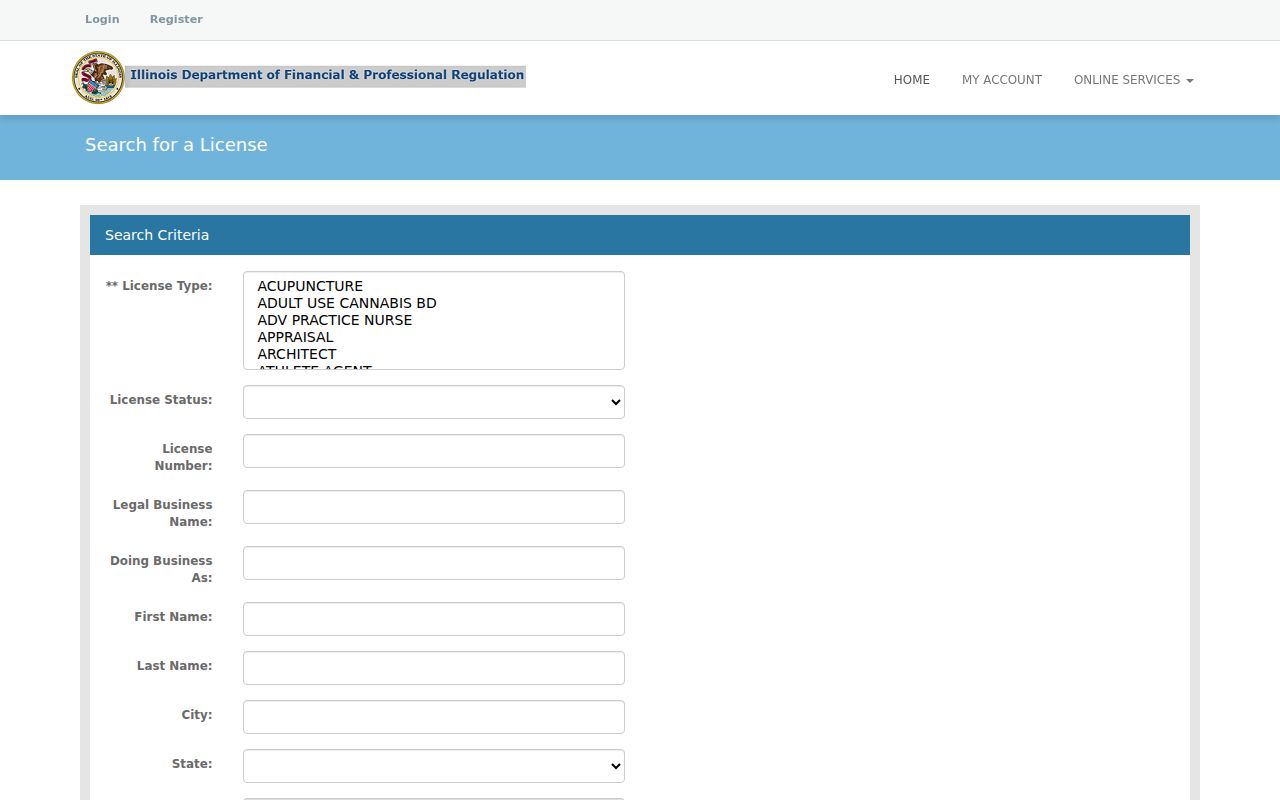
The form gives a direct official check for a claimed credential, while the result still needs a name and license-number match.
Separate Resident and Custody Results
Some official name searches answer a public-safety or custody question, not a residence question. The Illinois State Police registry and Illinois Department of Corrections inmate search have their own statutory scope and warnings. A result should be read only for the fields, date, and status the agency reports. It should never be blended with an assessor or voter hit merely because a name matches.
The official Illinois State Police search capture below is included because it is assigned to the Algonquin resident lookup manifest.
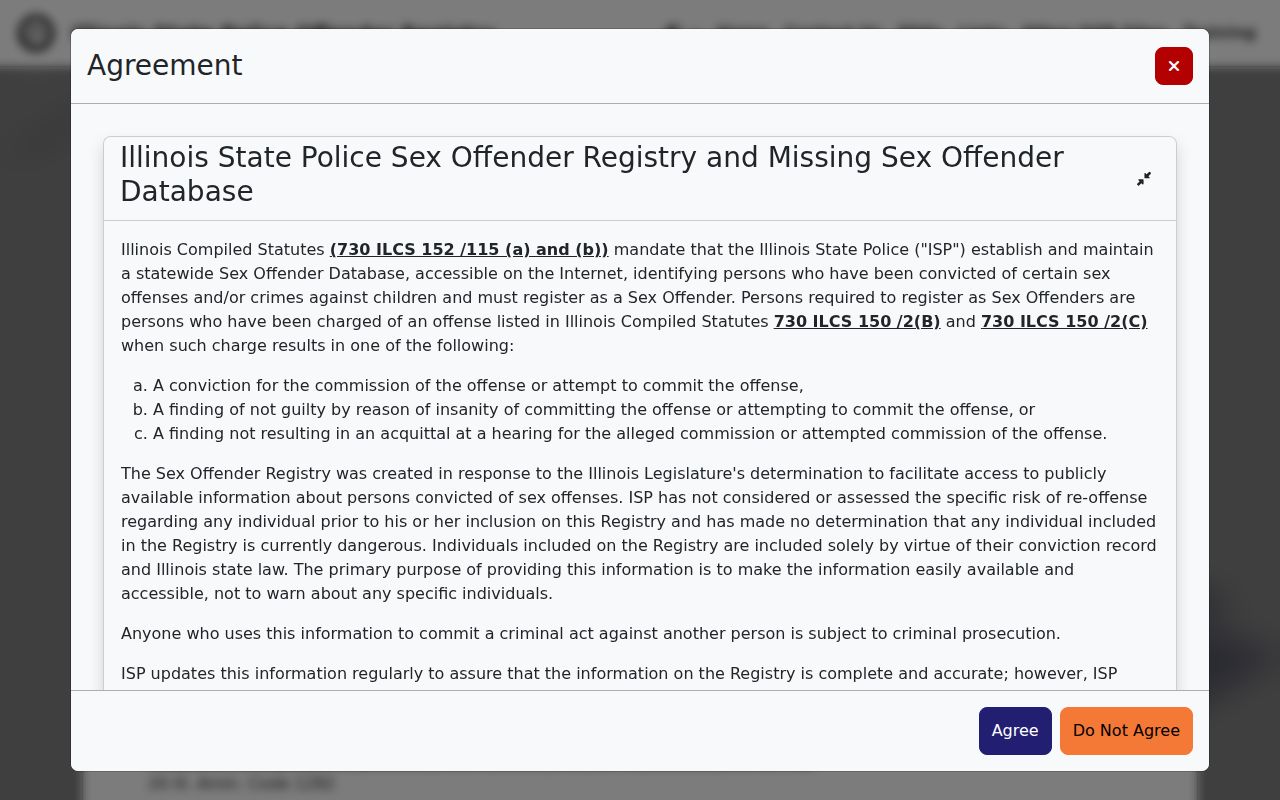
Read the agency disclaimer before searching. Registry fields and map tools do not form a general directory of Algonquin residents, and name-only matching is not enough.
The Illinois Department of Corrections image below shows the separate official inmate-search route.
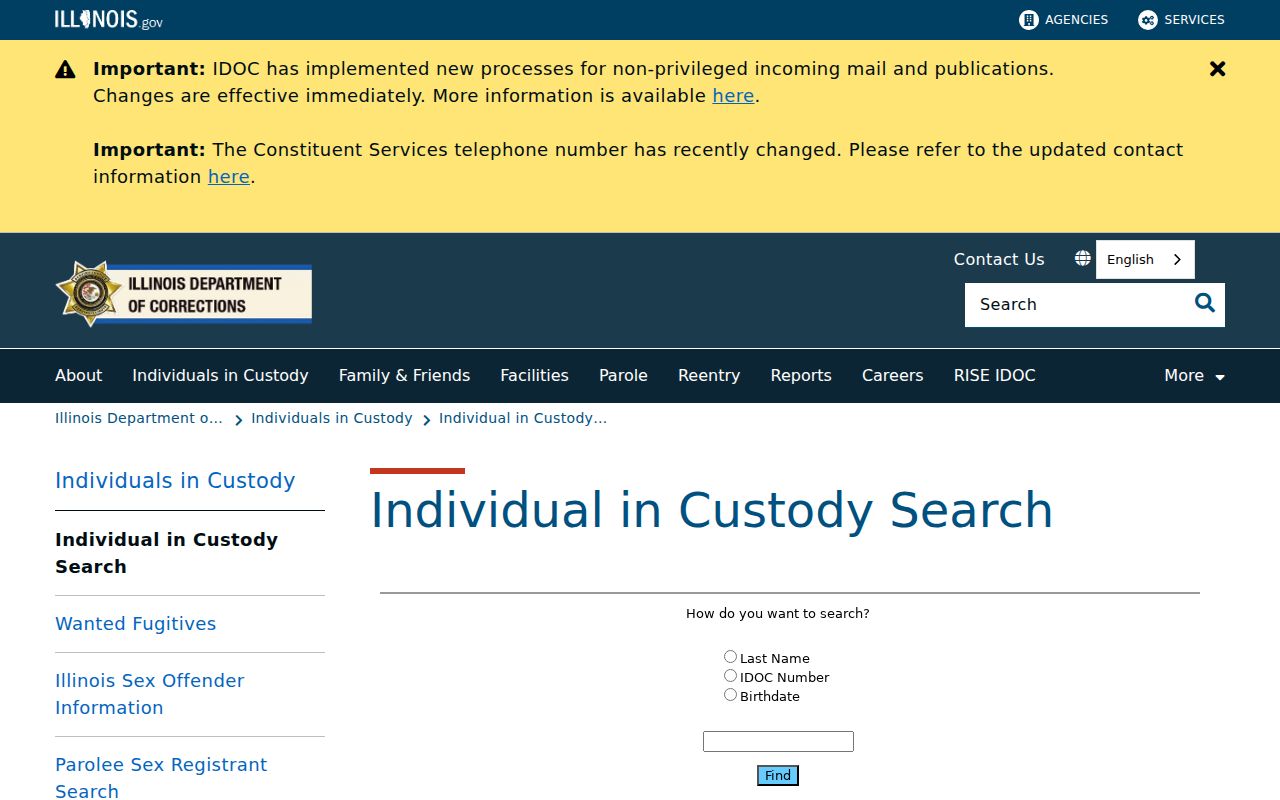
IDOC reports current or former custody and parole information within its coverage. It is not a complete historical archive and does not establish a current Algonquin address. Verify an actual court matter through the appropriate circuit clerk and read the disposition.
Privacy Limits for Algonquin Lookups
Illinois does not make every resident detail public. Vital certificates have eligibility rules. Court systems withhold sealed, impounded, expunged, juvenile, and other protected files. FOIA permits redaction of private information. Driver data is not a general name-and-address lookup, and voter-file access is narrower than many people assume.
The Illinois Address Confidentiality Program gives qualifying survivors a substitute address and mail forwarding for four years. Agencies accept it for new records within the program. The program cannot erase old records or guarantee that property records stay confidential. That limit matters when a resident lookup reaches an apparent gap.
Lawful use. Use Algonquin public records for a legitimate personal purpose. Never build or share an address trail to stalk, harass, intimidate, or harm a person.
Correct an inaccurate source record with the assessor, recorder, clerk, court, IDPH, or licensing agency. Removing a copied entry from a commercial compilation does not change the official record. When the official trail ends at a safety rule, sealed file, or eligibility gate, stop there.